
Indias Digital Public Infrastructure. The India Stack as the Next Global Export
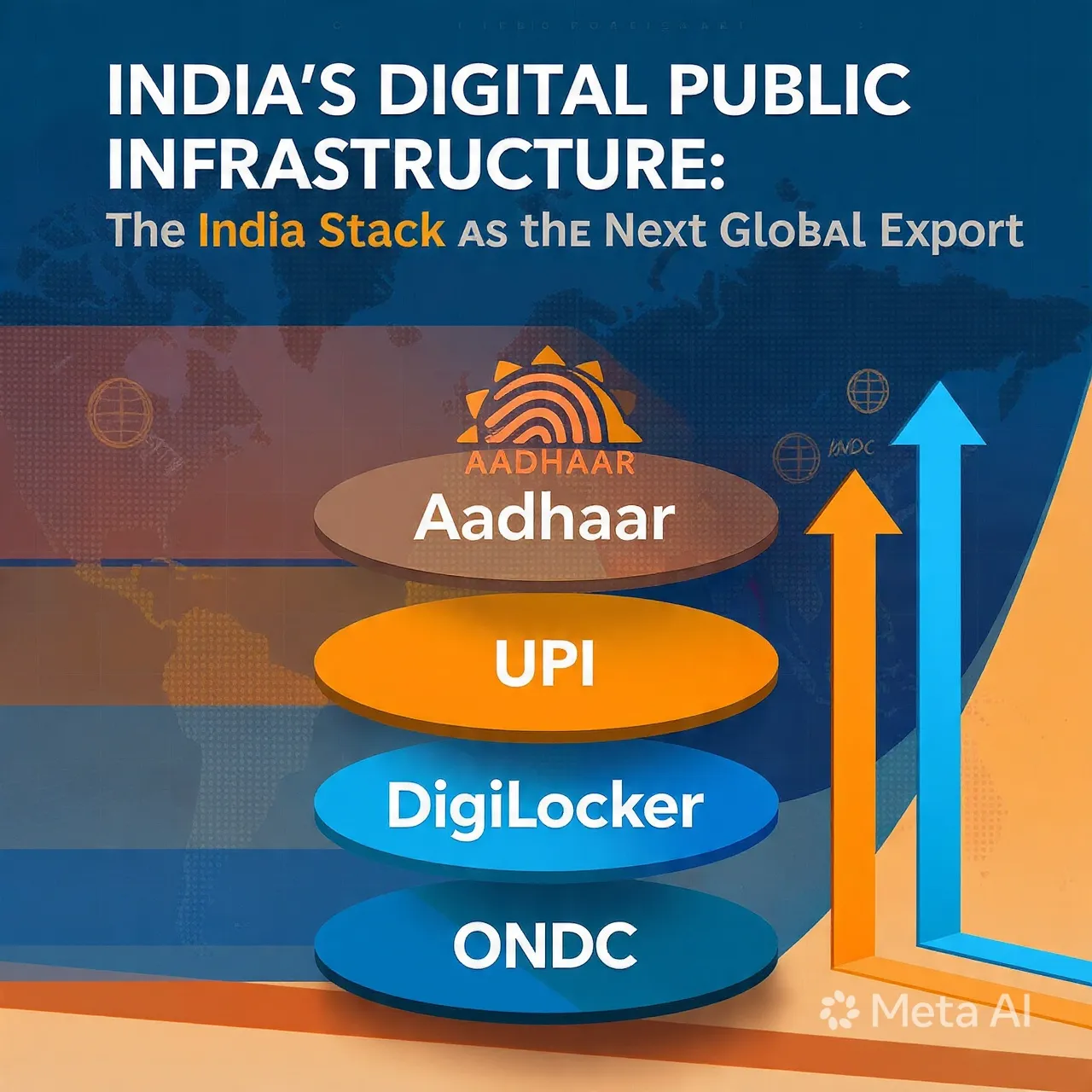
In the global race for technological influence, a new and unlikely champion has emerged: India's Digital Public Infrastructure (DPI). Forget just exporting software services or IT talent. India is now exporting a societal operating system—a foundational, open-source digital framework that is reshaping economies from the Philippines and Morocco to France and Armenia.
This isn't just another e-government initiative. This is a paradigm shift in how nations can digitally empower their citizens. At its core is the "India Stack"—a trio of revolutionary platforms: Aadhaar (digital identity), UPI (instant payments), and OCEN/ONDC (credit and commerce). Together, they form a public good that rivals the transformative impact of the internet itself.
Let's break down this powerful trifecta and explore why it’s becoming the blueprint for the 21st-century digital state.
Part 1: Deconstructing the India Stack – More Than Just Apps
1. Aadhaar: The "Digital Passport" (Identity Layer)
What it is: The world's largest biometric digital ID system. Over 1.3 billion Indians have a unique 12-digit number, verified by fingerprints and iris scans.
The Genius: It's foundational, not functional. Aadhaar doesn't store personal details, history, or caste/religion data. It simply answers one question: "Are you who you say you are?" This makes it a plumbing layer for the economy.
Impact: It slashed welfare fraud, enabled direct benefit transfers (saving an estimated $33+ billion), and allowed a migrant worker to open a bank account in minutes with no physical paperwork. It solved the "I have no ID" problem for hundreds of millions.
2. UPI: The "Financial Leveller" (Payments Layer)
What it is: The Unified Payments Interface—a real-time, mobile-based payments system.
The Genius: It's interoperable and open. Any bank, any wallet app (PhonePe, Google Pay, Paytm), any person can send money to any other person or merchant instantly, for free. It broke the walled gardens of proprietary banking systems.
The Scale: Processing over 12 billion transactions monthly (more than all global credit card networks combined), it has made digital payments ubiquitous for street vendors and billionaires alike. QR codes are now more common than card machines.
3. ONDC & OCEN: The "Market Democratizers" (Data & Commerce Layers)
What they are:
ONDC (Open Network for Digital Commerce): A protocol, not an app. It aims to break the dominance of e-commerce giants like Amazon and Flipkart by creating an open marketplace where any small retailer can be discovered by any buyer on any participating app.
OCEN (Open Credit Enablement Network): A standardized "credit rail" that allows lenders to offer small, digital loans to individuals and micro-businesses based on their digital footprint (UPI history, GST filings) rather than traditional collateral.
The Genius: They attack the last bastions of the analog economy—commerce and credit—by creating open, decentralized networks that foster competition and inclusion.
Part 2: The Core Principles – Why It Works
The India Stack's power isn't just in its parts, but in its design philosophy:
Public Infrastructure, Private Innovation: The government built the public rails (Aadhaar authentication, UPI protocol). The private sector built the engines and coaches—the intuitive apps (PhonePe, Cred), business models, and user experiences. This avoids government tech bloat and harnesses market creativity.
"Presence-less, Paper-less, Cash-less": The mantra. You don't need to be physically present, you don't need paperwork, and cash is optional. This drastically reduces friction and cost.
Consent-Based Data Empowerment: Frameworks like Data Empowerment and Protection Architecture (DEPA) aim to give individuals control over their own data, allowing them to securely share their financial history with a lender of their choice. This flips the data ownership model from corporations to citizens.
Part 3: The Global Rush – From Africa to Europe
Nations are not just admiring India's DPI; they are actively importing it. This is where the "export" narrative takes shape.
The Philippines has launched Bills Pay PH, a UPI-inspired instant payment system.
Morocco, Nigeria, and Senegal are implementing Aadhaar-like digital ID systems, often with India's technical assistance.
France has partnered with India to use UPI at the Eiffel Tower, signaling a tech diplomacy win.
Armenia, Papua New Guinea, and Sierra Leone have signed MoUs to adopt the India Stack.
The World Bank and IMF now champion DPI as a critical tool for financial inclusion and resilient economies.
Why the global adoption?
Leapfrog Potential: Developing nations see a chance to skip the costly, sequential development of legacy banking and ID systems, just as they skipped landlines for mobiles.
Cost & Scale Proven: India has stress-tested these systems at a billion-user scale. The code is often open-source, making adoption cheaper and faster than building from scratch.
Strategic Autonomy: For many nations, this is a compelling alternative to the US/China tech dichotomy. It's a non-aligned, democratic, and open-source model of digital governance. It offers a "third way."
Solving Real Problems: It directly addresses UN Sustainable Development Goals—reducing inequality, fostering innovation, and creating efficient institutions.
Part 4: Challenges & The Road Ahead
The model is not without its critics or hurdles:
Privacy & Surveillance: A centralised ID system raises legitimate fears of state overreach. India's Supreme Court has upheld privacy as a fundamental right, but the legal-technical balance is a work in progress.
Digital Divides: While penetration is vast, disparities in access to smartphones, digital literacy, and connectivity among women, the elderly, and rural populations persist.
Commercial Viability: UPI's success has come at a cost—the lack of a clear revenue model for banks and payment service providers is a point of contention.
Geopolitical Packaging: For India, exporting DPI is a soft power victory. But it must be offered as a global public good, not tied with political strings, to be truly accepted.
Conclusion: The Protocol for Prosperity?
India's DPI represents a fundamental idea: that in the digital age, the most critical infrastructure isn't just roads and ports, but open, interoperable protocols for identity, money, and data.
It has shown that technology, when architected as a public good, can be profoundly inclusive rather than exclusive. It doesn't just create tech billionaires; it empowers street vendors, small farmers, and gig workers.
As the world grapples with digital fragmentation, data sovereignty, and financial exclusion, India's DPI offers a replicable, scalable blueprint. It may not be a physical export like steel or cars, but as a "protocol for prosperity," its potential to reshape global digital governance is immense. The "India Stack" is quietly becoming the most influential tech export of the 21st century, proving that sometimes, the most revolutionary ideas come not from Silicon Valley, but from solving the complex, human problems of a billion people.